
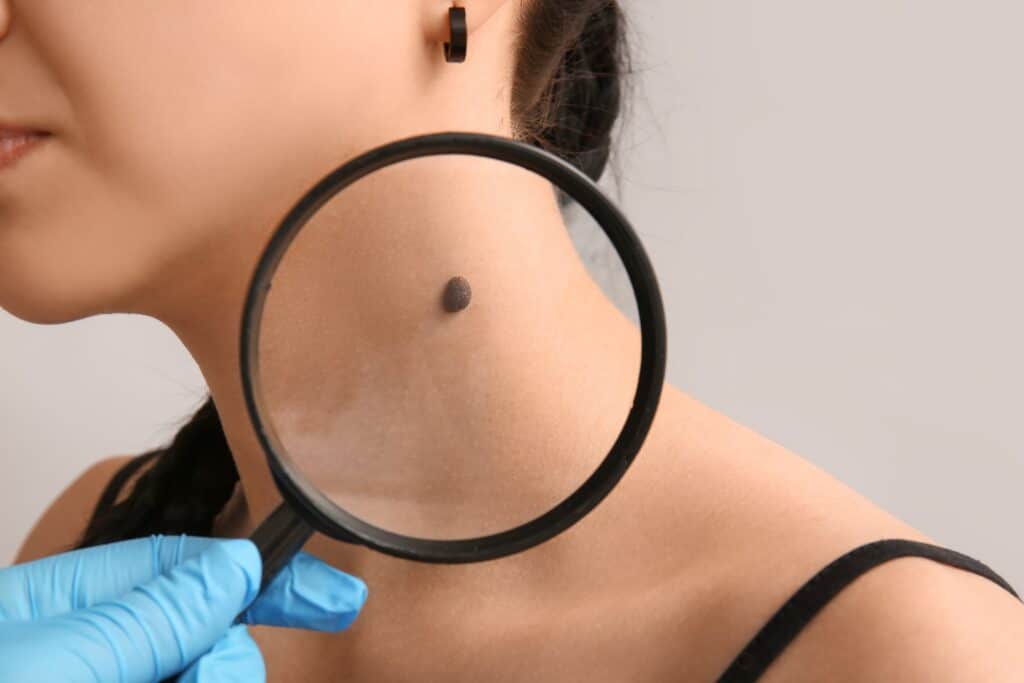
Moles are incredibly common, yet many people are unsure why they develop or why they differ in appearance. Some moles are present at birth, while others appear gradually through childhood and adulthood. Knowing the difference between congenital and acquired moles can help you better understand your skin and when to seek a professional evaluation.
At SkinSmart Dermatology in Sarasota, Dr. Elizabeth F. Callahan and our experienced team assess and monitor all types of moles with precision and care. Dr. Callahan is a double board-certified dermatologist and dermatologic surgeon with advanced training in medical skincare, like cancer evaluation and dermoscopy. Her expertise helps patients feel confident about their skin health while receiving accurate, thorough assessments.
What Are Congenital Moles?
Congenital moles, also called congenital nevi, are present at birth or develop shortly after. These moles form during fetal development when pigment cells cluster in one area. Congenital moles vary widely in shape, size, and color, and they may grow as the child grows.
Some key characteristics include:
- Present at birth: Visible immediately or within the first few months.
- Wider size range: Can be small or large.
- Potential texture differences: May be smooth, raised, or have hair growth.
These traits help distinguish congenital moles from those that develop later in life.
What Are Acquired Moles?
Acquired moles typically form during childhood, adolescence, or early adulthood. They develop when pigment cells multiply due to genetics, sun exposure, or a combination of factors. Most adults have between 10 and 40 acquired moles.
Common features include:
- Appear later in life: Usually after early childhood.
- Influenced by sun exposure: UV light can trigger the formation of new moles.
- Often uniform: Typically round and evenly colored.
Although acquired moles are usually harmless, changes in size, shape, or color should be evaluated by Dr. Callahan.
When Should You Have a Mole Checked?
Knowing when to schedule a mole evaluation helps you stay aware of changes that may matter. Most moles remain harmless, but any mole that changes or feels different should be checked.
Warning signs to watch for include:
- Asymmetry: One half does not match the other and suggests that the molecule’s structure is no longer uniform.
- Border irregularity: Edges appear uneven, jagged, or scalloped rather than smooth and well-defined.
- Color changes: Multiple shades of brown, black, red, or new areas of pigment can indicate abnormal cell activity.
- Diameter growth: A mole that grows larger than a pencil eraser or increases steadily in size should be examined.
- Evolution: Any noticeable change in shape, elevation, texture, or symptoms such as itching or burning.
Early detection plays a key role in ensuring the best outcomes for long-term skin health.
Learn More About Your Skin Health in Sarasota
If you want expert guidance on congenital or acquired moles, contact SkinSmart Dermatology in Sarasota, FL. Call 941-308-7546 to schedule a skin evaluation with Dr. Elizabeth Callahan for peace of mind and professional care.